


서 언
천남성속(Arisaema Mart.)은 택사목(Alismatales) 천남성과(Araceae)에 속하는 다년생 초본으로, 전 세계에 약 200종이 아메리카, 동아프리카, 동아시아를 포함한 광범위한 지역에 분포하며(POWO, https://powo.science.kew.org/, 2026), 한국에서는 주로 4–7월에 개화하고 그늘진 산림 하층에서 흔히 관찰된다. 천남성속은 다양한 환경에 적응성이 높은 분류군이고, 계절성 또는 상록성이며, 단성 또는 양성화서를 가지는 식물이다. 줄기는 괴경 혹은 근경을 가지고, 위경(pseudostem)이 있거나 없고, 잎은 삼출엽(trifoliolate)에서 장상엽(pedate), 조족엽(palmate)까지 다양하다. 육수화서는 단성이거나 양성이며 부속체(spadix)의 형태 변이가 매우 크다(Choi, 2023; Tran et al., 2022). 한국산 천남성속에 관한 최초의 보고는 Palibin (1901)에 의해 이루어졌으며, 그는 A. amurense β robustum (=A. amurense Maxim, 둥근잎천남성)과 A. ringens α sieboldii (= A. ringens (Thunb.) Schott, 큰천남성)의 한국 분포를 기록하였다. 이후 Komarov (1901)은 2종, Nakai (1911)은 4종 1변종 그리고 Mori (1922)은 5종 4품종으로 한국의 천남성속을 정리한 바 있다 (Table 1). Nakai (1929)는 일본과 한국에 분포하는 천남성속 분류군을 sect. Tortuosa, sect. Pistillata, sect. Ringentia의 세 절로 정리하고, 이 가운데 한국에서는 5종 6변종이 존재한다고 보고하였다. 이후 Nakai (1952)는 세 절 구분 대신 Arisaema, Flagellariasaema, Ringentiarum, Heteroarisaema, Pleuriarum의 다섯 개의 속(genera)으로 제시하는 한편, 천남성속 내부에는 세 절(sect. Colocasiarum, sect. Sinarisaema, sect. Pistillata)로 세분화하고, 14종 8변종 1품종으로 재정리하였다. Lee (1976)는 8종 6변종 1품종으로 정리하였고, Ko and Kim (1985)은 형태·세포학적 증거를 바탕으로 한국산 천남성속을 sect. Pistillata, sect. Tortuosa, sect. Arisaema의 세 절로 재정리하면서 8종 5품종을 보고하였다. Lee (1993)는 이후 5종 2변종으로 분류 체계를 재정리하였다. Lee (1996)는 4종 3변종 1아종을 보고하였고, Lee (2006)는 1아종을 제외하고 1종 1품종을 추가하여 5종 3변종 1품종으로 재정리하였다. Ko et al. (2006)는 거문천남성(A. thunbergii subsp. geomundoense S.Ko)을 신아종으로 발표하였다. 이후 『The Genera of Vascular Plants of Korea』 (2007)에서는 6종이 인정되었고, Chang et al. (2014)은 섬남성(A. takesimense Nakai)을 제외하는 대신 섬천남성(A. negishii Makino)과 2아종을 포함하여 6종 2아종으로 보고하였다(Table 1). 이처럼 연구자·시기별로 한국산 천남성속 분류군의 인정 범위와 분류학적 처리, 분포 판단에 차이가 존재해 왔다. 특히 천남성(A. amurense var. serratum Nakai)-둥근잎천남성, 점박이천남성(A. serratum Schott)-섬남성 사이의 형태적 연속성으로 인한 종 경계에 대한 논란이 지속되어 왔다(Choi, 2023; Kim et al., 2014; Ko and Kim, 1985; Noh et al., 2018). 천남성속 식물은 육수화서, 불염포 등 독특한 화서 구조로 인해 관상적 가치가 인정되어 일부 종이 원예적으로 도입·재배되고 있다(Mat-Zain et al., 2023; Mayo and Hall, 1984). 또한 한국, 일본, 중국 등의 아시아 지역에서는 천남성속 식물의 괴경을 이용해 중풍, 얼굴신경마비, 급성 및 만성기관지염 등을 치료하는 약재로 사용해 왔다(Noh et al., 2018; Qi et al., 2021). 이처럼 관상 및 약용 자원으로서의 활용을 고려할 때(Lee et al., 2026), 국내 자생 천남성속 분류군에 대한 정확한 동정과 분류 체계 정립이 요구된다
이에 따라, 본 연구에서는 한국에 자생하는 천남성속 식물들 중 sect. Pistillata에 속하는 4분류군(천남성, 둥근잎천남성, 점박이천남성, 섬남성)을 대상으로 문헌·표본 사진을 바탕으로 외부 형태학적 형질을 비교하여 기존에 사용되어 온 진단 형질의 유효성을 검토하고, 외부 형태학적, 분자적 연구를 통해 4분류군의 분류학적 위치를 재확인하고자 한다.
Table 1.
Recognition of Korean Arisaema taxa by source (1901-2014).
| Palibin (1901) | Komarov (1901) | Nakai (1911) | Mori (1922) | Nakai (1929) | Nakai (1952) | Lee (1976) | Ko and Kim (1985) | Lee (1993) | Lee (1996) | Lee (2006) | Ko et al. (2006) | Flora of Korea Editorial Committee (2007) | Chang et al. (2014) |
Accepted namey |
| A. amurense | A. amurense | A. amurense | A. amurense | A. amurense | A. amurense | A. amurense | A. amurense | A. amurense | ||||||
| A. amurense var. purpureum | A. amurense var. purpureum | |||||||||||||
| A. amurense var. serratum | A. amurense var. serratum | A. amurense var. serratum | A. amurense f. serratum | A. amurense var. serratum | A. amurense var. serratum | A. amurense var. serratum | ||||||||
| A. amurense β robustum | A. amurense var. violaceum | A. amurense var. violaceum | A. amurense var. violaceum | A. amurense f. violaceum | ||||||||||
| A. robustum | A. robustum | A. robustum | A. robustum | A. robustum | A. robustum | A. robustum | ||||||||
| A. robustum var. purpureum | A. robustum var. purpureum | |||||||||||||
| A. hetero- phyllum | A. hetero- phyllum | A. hetero- phyllum | A. hetero- phyllum | A. hetero- phyllum | A. hetero- phyllum | A. hetero- phyllum | A. hetero- phyllum | A. hetero- phyllum | A. hetero- phyllum | A. hetero- phyllum | ||||
| A. koreanum | ||||||||||||||
| A. manshu- ricum | ||||||||||||||
| A. japonicum | A. japonicum | A. japonicum | A. japonicum | |||||||||||
| A. takesimense | A. takesimense | A. takesimense | A. takesimense | A. takesimense | A. takesimense | A. takesimense | ||||||||
| A. negishii | A. negishii | A. negishii | A. negishii | A. negishii | A. negishii | A. negishii | A. negishii | |||||||
| A. glaucescens | A. ringens | |||||||||||||
| A. ringens | A. ringens | A. ringens | A. ringens | A. ringens | A. ringens | A. ringens | ||||||||
| A. ringens var. sieboldii | A. ringens var. sieboldii | |||||||||||||
| A. ringens α sieboldii | A. ringens α sieboldii | |||||||||||||
| A. serratum | A. serratum | A. serratum | ||||||||||||
| A. angustatum var. peninsulae | A. angustatum var. peninsulae | A. angustatum var. peninsulae | A. angustatum var. peninsulae | A. serratum var. serratum | ||||||||||
| A. convolutum | A. convolutum | A. convolutum | ||||||||||||
| A. peninsulae | A. peninsulae | A. peninsulae | A. peninsulae | A. serratum var. serratum | ||||||||||
| A. peninsulae var. caespitosum | A. peninsulae var. caespitosum | A. peninsulae f. convolutum | ||||||||||||
| A. peninsulae f. variegatum | ||||||||||||||
| A. thunbergii | A. thunbergii | A. thunbergii | A. thunbergii | A. thunbergii | A. thunbergii | A. thunbergii | A. thunbergii | A. thunbergii | ||||||
| A. urashima | A. thunbergii subsp. urashima | A. thunbergii subsp. geomundoense | A. thunbergii subsp. thunbergii | A. thunbergii subsp. urashima | ||||||||||
| A. japonicum var. atropurpureum | A. amurense var. typicum | A. amurense var. typicum | A. angustatum var. atropur- pureum | A. robustum f. purpureum | A. thunbergii var. thunbergii | A. thunbergii var. thunbergii | - | |||||||
| A. japonicum var. caespitosum | A. peninsulae var. atropurpureum | A. peninsulae var. atropurpureum | A. angustatum var. caespitosum | |||||||||||
| A. peninsulae var. attenuatum | A. angustatum var. peninsulae for. variegatum | |||||||||||||
| A. kiushianum | ||||||||||||||
| 2 spp.z | 2 spp. | 4 spp. 1 var. | 5 spp. 4 f. |
5 spp. 6 var. |
14 spp. 8 var.1 f. |
8 spp. 6 var. 1 f. | 8 spp. 5 f. | 5 spp. 2 var. |
4 spp. 2 var. 1 subsp. |
5 spp. 3 var. 1 f. |
+1 new subspecies | 6 spp. |
6 spp. 2 subsp. |
yAccepted name: POWO (https://powo.science.kew.org/, 2026).
재료 및 방법
재료
본 연구에서는 2025년 6월 울릉도 자생지에서 채집한 섬남성의 생체 시료와 경북대학교 표본전시관(KNU), 국립수목원 표본전시관(KH), 국립낙동강생물자원관 표본전시관(NNH)에 소장된 건조표본을 직접 방문 또는 대여하여 관찰하였다. 자생지에서 채집한 생체 시료는 Lee (1996, 2006) 등의 문헌을 이용하여 동정하였고, 이후 표본화하여 경북대학교 표본전시관(KNU)에 보관하였다. 사용된 개체표본의 수는 천남성 20개체, 둥근잎천남성 29개체, 점박이천남성 17개체, 섬남성 15개체로 총 81개체이다(Appendix 1).
방법
정량·정성 형태학적 형질은 육안 관찰과 전자식 버니어 캘리퍼스(CD-15CPX; Mitutoyo, Kawasaki, Japan)로 측정하였다. 측정에 사용한 표본 목록은 Appendix 1에 수록하였다.
형태형질의 변이 패턴을 확인하기 위해 R프로그램을 통해 주성분 분석(Principal component analysis, PCA)을 수행하였다. PCA를 통해 분류군 간 형태 변이에 기여하는 주요 형질을 파악하였으며, 결과는 2차원 PCA biplot으로 시각화하였다. PCA는 결측치가 포함된 자료는 분석에서 제외하고 분석을 수행하였다.
DNA 추출은 생체 혹은 건조표본을 통해서 Qiagen DNeasy Plant Mini kit (Qiagen)을 이용해 total DNA를 추출하였다. 천남성 6개체, 둥근잎천남성 4개체, 점박이천남성 3개체, 섬남성 3개체에서 DNA를 추출하였으며, 추출한 DNA는 nrDNA의 ITS 지역을 활용하여 염기서열을 확보하였고, NCBI에 등록된 천남성속 염기서열을 더하여 분석을 수행하였다. 확보된 염기서열은 Geneious Prime 프로그램(https://www.geneious.com)의 MAFFT (Katoh and Standley, 2013)를 이용하여 정렬하였다. Maximum likelihood (ML) tree 확인을 위해 RAxML 프로그램(Stamatakis, 2014)을 사용하였고, GTRGAMMA 모델을 적용하여 1,000회 반복 분석을 통해 각 분지의 bootstrap value를 평가하였다.
Split network는 SplitsTree v6.4.7 프로그램(Huson and Bryant, 2006)을 이용하여 uncorrected_P 거리와 NeighborNet 방법으로 1,000회 반복 분석을 시행하였다.
결 과
한국산 천남성속(Arisaema) sect. Pistillata 4분류군의 주요 외부 형태학적 형질을 관찰하고 기재하였다. 부속체 기부의 존재 여부, 부속체의 형태, 불염포의 모양, 줄기의 무늬 유무, 엽연의 거치, 잎 수, 잎 모양, 소엽의 수와 길이, 폭, 모양 등 질적, 양적 형질 기재는 Table 2, 3에 제시하였다.
형태 형질 분석
줄기
줄기의 무늬는 천남성과 둥근잎천남성에서는 관찰되지 않았으며, 점박이천남성과 섬남성에서만 관찰되었다. 점박이천남성 62.5% (10개체/16개체), 섬남성 53.3% (8개체/15개체)에서 무늬가 관찰되었다(Table 2).
잎
1. 소엽 모양
주로 타원형, 도란형, 장타원형으로 구분되었으며, 천남성·둥근잎천남성·점박이천남성에서는 타원형과 도란형이 주로 나타난 반면 섬남성에서는 장타원형의 비율이 높았다(Table 2).
2. 엽선
예두(acute), 점첨두(acuminate), 소첨두(apiculate), 까락첨두(aristate), 미두(caudate), 둔두(obtuse)의 엽선 유형이 확인되었다. 전 분류군에서 점첨두가 가장 흔했고 예두가 그 다음으로 많았다(Table 2).
Table 2.
Qualitative characters of Arisaema sect. Pistillata in Korea.
Character Taxon | Flower | Spathe | Stem | Leaf | ||||||||||
|
Spadix shape |
Spadix attitude |
Peduncle - leaf height | Spadix base | Limb shape | Limb apex | Striation | Maculation | Leaf type |
Petiole length comparison |
Leaflet shapez | Leaflet apexz |
Leaflet variegation |
Leaflet margin | |
| A. amurense var. serratum (N=20) |
cylindrical (88.9%) clavate (5.6%) fusiform (5.6%) |
erect (94.4%) bent forward (5.6%) |
leaf > peduncle (90.0%) leaf = peduncle (5.0%) leaf < peduncle (5.0%) |
stipitate (100.0%) |
ovate (66.7%) elliptical (20.0%) obovate (13.3%) |
acute (84.2%) acuminate (15.7%) |
present (82.4%) absent (17.6%) |
absent (100.0%) |
palmate (100.0%) |
terminal > lateral (63.2%) terminal = lateral (21.1%) |
elliptical (75.0%) obovate (55.0%) oblong (25.0%) |
acute (45.0%) acuminate (60.0%) apiculate (30.0%) caudate (5.0%) |
present (10.0%) absent (90.0%) |
serrate (100.0%) |
| Coverage (n) | 18 | 18 | 20 | 19 | 15 | 19 | 17 | 20 | 20 | 19 | 20 | 20 | 20 | 20 |
| A. amurense (N=29) |
cylindrical (92.9%) clavate (7.1%) |
erect (92.9%) bent forward (7.1%) |
leaf > peduncle (100.0%) |
stipitate (100.0%) |
ovate (84.0%) elliptical (8.0%) |
acute (84.0%) acuminate (16.0%) |
present (80.8%) absent (19.2%) |
absent (100.0%) |
palmate (100.0%) |
terminal > lateral (48.3%) terminal = lateral (27.6%) terminal < lateral (10.3%) |
elliptical (72.4%) obovate (65.5%) oblong (31.0%) |
acute (31.0%) acuminate (89.7%) apiculate (6.9%) obtuse (3.5%) |
present (3.6%) absent (96.4%) |
entire (100.0%) |
| Coverage (n) | 28 | 28 | 29 | 29 | 25 | 25 | 26 | 29 | 29 | 29 | 29 | 29 | 28 | 29 |
| A. serratum (N=17) |
cylindrical (69.2%) clavate (30.8%) |
erect (50.0%) bent forward (50.0%) |
leaf > peduncle (68.8%) leaf = peduncle (12.5%) leaf < peduncle (18.8%) |
stipitate (100.0%) |
ovate (77.8%) elliptical (22.2%) |
acute (30.0%) acuminate (60.0%) caudate (10.0%) |
present (23.1%) absent (76.9%) |
present (62.5%) absent (37.5%) |
palmate (11.8%) pedate (88.2%) |
terminal > lateral (92.3%) terminal = lateral (7.7%) |
elliptical (70.6%) obovate (35.3%) oblong (41.2%) |
acute (33.3%) acuminate (73.3%) aristate (6.7%) |
absent (100.0%) |
entire (94.1%) serrate (5.9%) |
| Coverage (n) | 13 | 12 | 16 | 13 | 9 | 10 | 13 | 16 | 17 | 13 | 17 | 15 | 17 | 17 |
| A. takesimense (N=15) |
cylindrical (15.4%) clavate (84.6%) |
erect (91.7%) bent forward (8.3%) |
leaf > peduncle (60.0%) leaf = peduncle (30.0%) leaf < peduncle (10.0%) |
stipitate (100.0%) |
ovate (20.0%) elliptical (50.0%) oblong (30.0%) |
acuminate (100.0%) |
present (33.3%) absent (66.7%) |
present (53.3%) absent (46.7%) |
pedate (100.0%) |
terminal > lateral (80.0%) terminal = lateral (6.7%) terminal < lateral (13.3%) |
elliptical (6.7%) oblong (93.3%) |
acute (26.7%) acuminate (91.7%) |
present (66.7%) absent (33.3%) |
entire (86.7%) serrate (13.3%) |
| Coverage (n) | 13 | 13 | 10 | 14 | 10 | 10 | 12 | 15 | 15 | 15 | 15 | 15 | 15 | 15 |
3. 소엽의 무늬
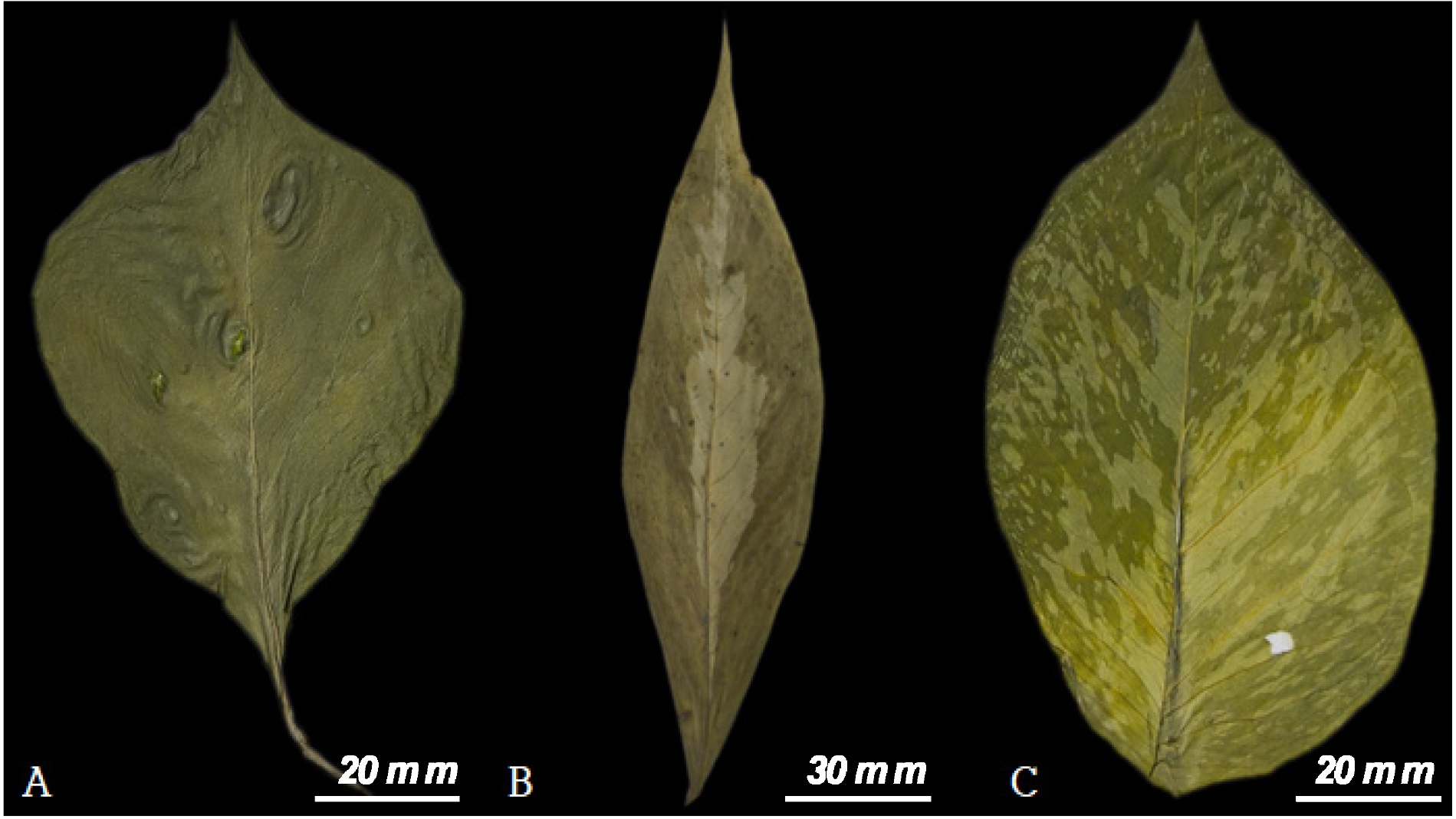
점박이천남성에서는 무늬가 관찰되지 않은 반면(Fig. 1A) 섬남성은 소엽 표면 주맥 부근에 백색 무늬가 뚜렷하게 관찰되었다(Fig. 1B). 주맥 부근에 무늬가 있던 섬남성과 달리 천남성과 둥근잎천남성에서는 대부분 무늬가 없었으나 소엽 표면 전반에 백색 점상 무늬를 가진 개체가 일부 관찰되었다(Fig. 1C).
4. 엽연의 거치
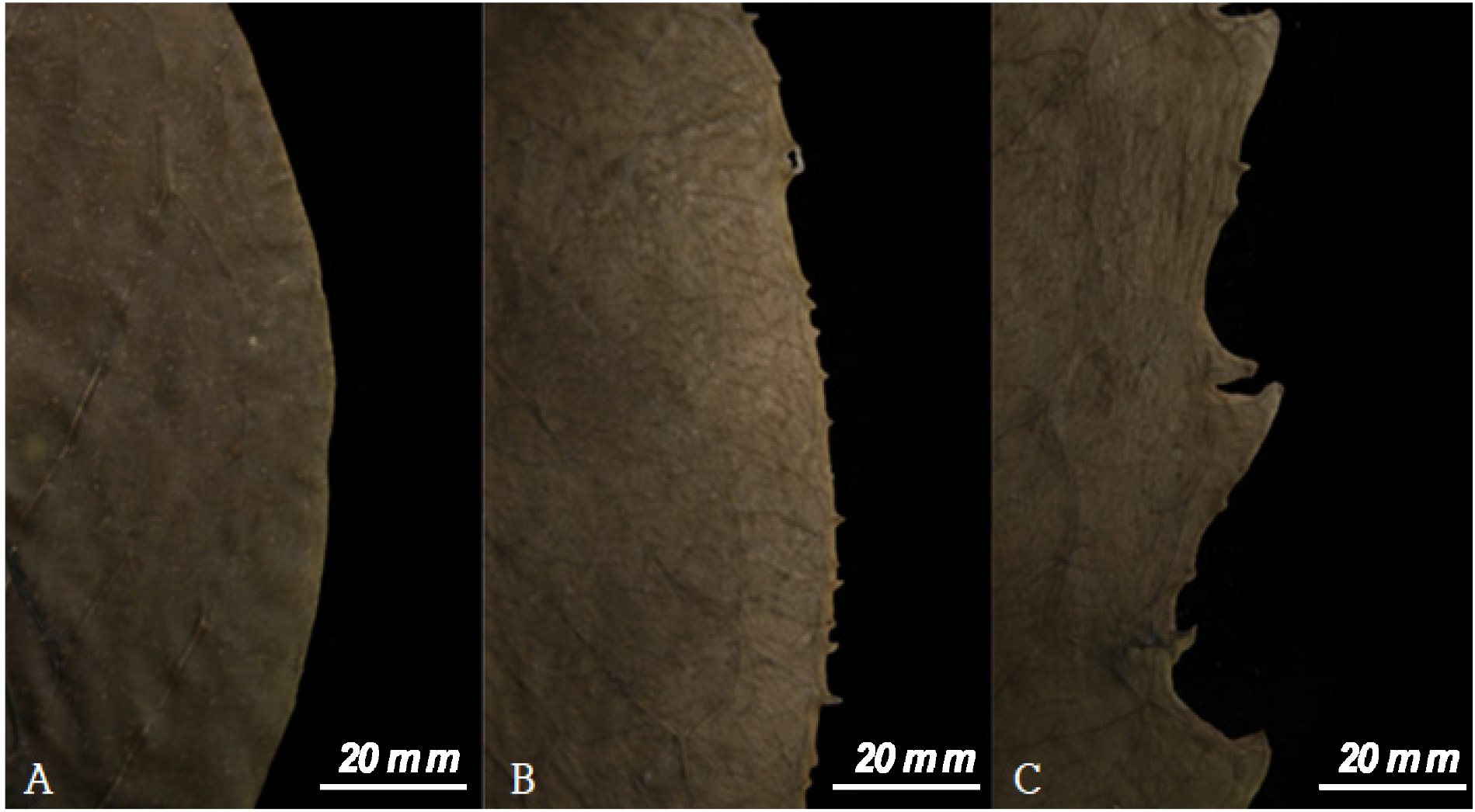
천남성은 전 개체에서 거치가 있으나 미세거치에서 현저한 거치까지 발달 정도의 변이를 보였다(Fig. 2B, C). 둥근잎천남성의 경우 모든 개체에서 전연으로 관찰되었고(Fig. 2A), 점박이천남성과 섬남성은 대부분 전연이었으나 일부 거치가 있는 개체가 관찰되었다(Fig. 2B, C).
꽃
1. 부속체 형태
천남성과 둥근잎천남성의 경우 원통형(cylindrical) 모양의 부속체가 가장 많이(16개체/18개체, 26개체/28개체) 관찰되었고, 그 외에 곤봉형(clavate)과 방추형(fusiform)이 관찰되었다. 점박이천남성은 원통형이 69.2%(9개체/13개체), 곤봉형이 30.8%(4개체/13개체)로 두 형태가 공존하였다. 이에 반해 섬남성은 곤봉형이 84.6%(11개체/13개체)로 대부분을 차지하였고, 원통형도 일부 확인되었다(Table 2).
2. 부속체 길이와 너비
부속체 평균 길이는 천남성 32.2 ㎜, 둥근잎천남성 35.5 ㎜, 점박이천남성 36.4 ㎜, 섬남성 45.5 ㎜로 나타났다. 평균 너비는 각각 천남성이 4.2 ㎜, 둥근잎천남성 4.3 ㎜, 점박이천남성이 3.5 ㎜, 섬남성이 5.6 ㎜로 측정되었다(Table 3).
불염포
1. 불염포 길이와 너비
불염포 평균 길이는 천남성이 99.5 ㎜, 둥근잎천남성 103.4 ㎜, 점박이천남성 109.9 ㎜, 섬남성 145.8 ㎜로 나타났다. 평균 너비는 천남성이 27.7 ㎜, 둥근잎천남성 30.8 ㎜, 점박이천남성 27.1 ㎜, 섬남성 27.0 ㎜로 측정되었다(Table 3).
Table 3.
Quantitative characters of Arisaema sect. Pistillata in Korea [min-(mean)-max].
PCA 분석
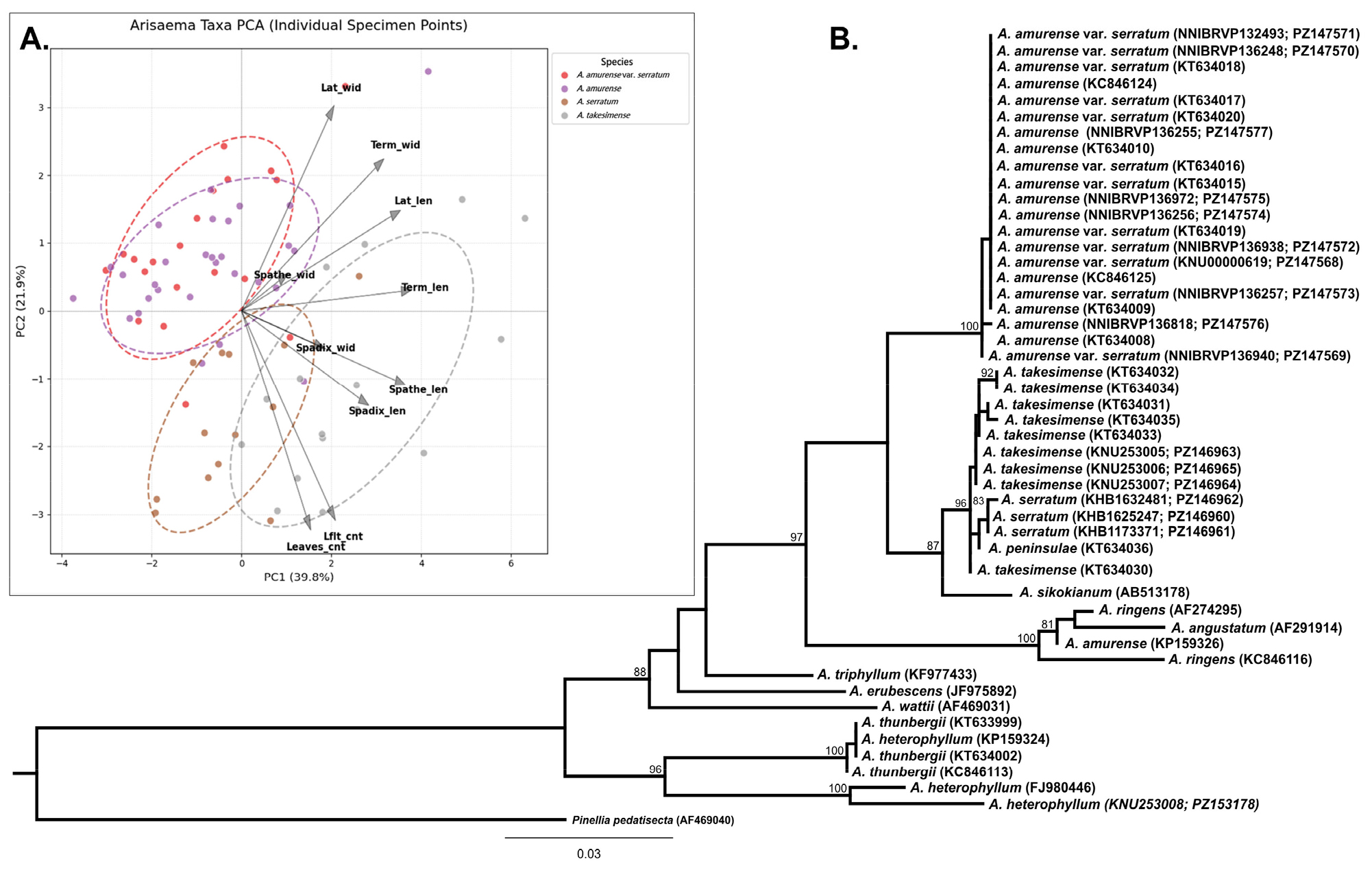
형태 형질 자료에 대한 주성분 분석(PCA) 결과, 주성분 1은 전체 변이의 39.8%, 주성분 2는 21.9%를 설명하였으며, 두 축이 합계 61.7%의 변이를 설명하였다. 천남성과 둥근잎천남성의 경우 PCA 좌표상에서 개체들이 상당 부분 중첩되어 두 분류군 간 형태적 경계가 명확하지 않은 양상을 보였다. 반면 점박이천남성과 섬남성은 제한적인 중첩이 확인되었다. 두 분류군의 표본은 PC1 축을 따라 상대적으로 분리되어 분포하였으며, 형태적 차이가 어느 정도 확인되는 경향을 보였다. 이러한 분리는 특히 정소엽의 길이(Term_len), 불염포 길이(Spathe_len), 부속체 길이(Spadix_len)과 같이 길이 관련 형질들이 두 분류군의 분리에 기여한 것으로 해석된다(Fig. 3A).
분자계통학적 연구
nrDNA ITS 염기서열을 바탕으로 분자계통학적 분석을 수행한 결과, 한국의 천남성속 sect. Pistillata 4분류군(천남성, 둥근잎천남성, 점박이천남성, 섬남성)은 크게 두 개의 분계조로 구분되었다. 첫 번째 분계조는 천남성과 둥근잎천남성이 하나의 분계조를 형성하였으며, 100% bootstrap value로 가까운 유연관계에 있는 것을 확인할 수 있다. 다만 일부 개체(KP159326)는 주된 군집에서 다소 벗어난 위치에 배열되었다. 두 번째 분계조는 점박이천남성과 섬남성이 혼재하여 형성하였고, 96% bootstrap value로 역시 가까운 유연관계를 이루고 있는 것을 확인할 수 있다. 그러나 분계조 내 일부 개체(KT634030)는 주된 군집과 비교하여 다소 벗어난 위치에 배열되는 양상을 보였다(Fig. 3B).
이러한 분기양상은 SplitsTree를 이용한 split network에서도 동일하게 나타났다(Fig. 4A). 천남성과 둥근잎천남성은 동일한 분계조 내에서 가까운 유연관계를 보이며 하나의 그룹을 형성하였다. 점박이천남성과 섬남성도 별도의 하나의 분계조를 형성하며 가까운 유연관계를 보였다. 염기서열 비교결과 천남성과 둥근잎천남성 사이에서는 염기차이가 거의 관찰되지 않았다. 섬남성과 점박이천남성 사이에서는 염기서열의 변이가 나타났지만, 일관적인 염기서열 변화로 나타나지는 않았다(Fig. 4B, C).
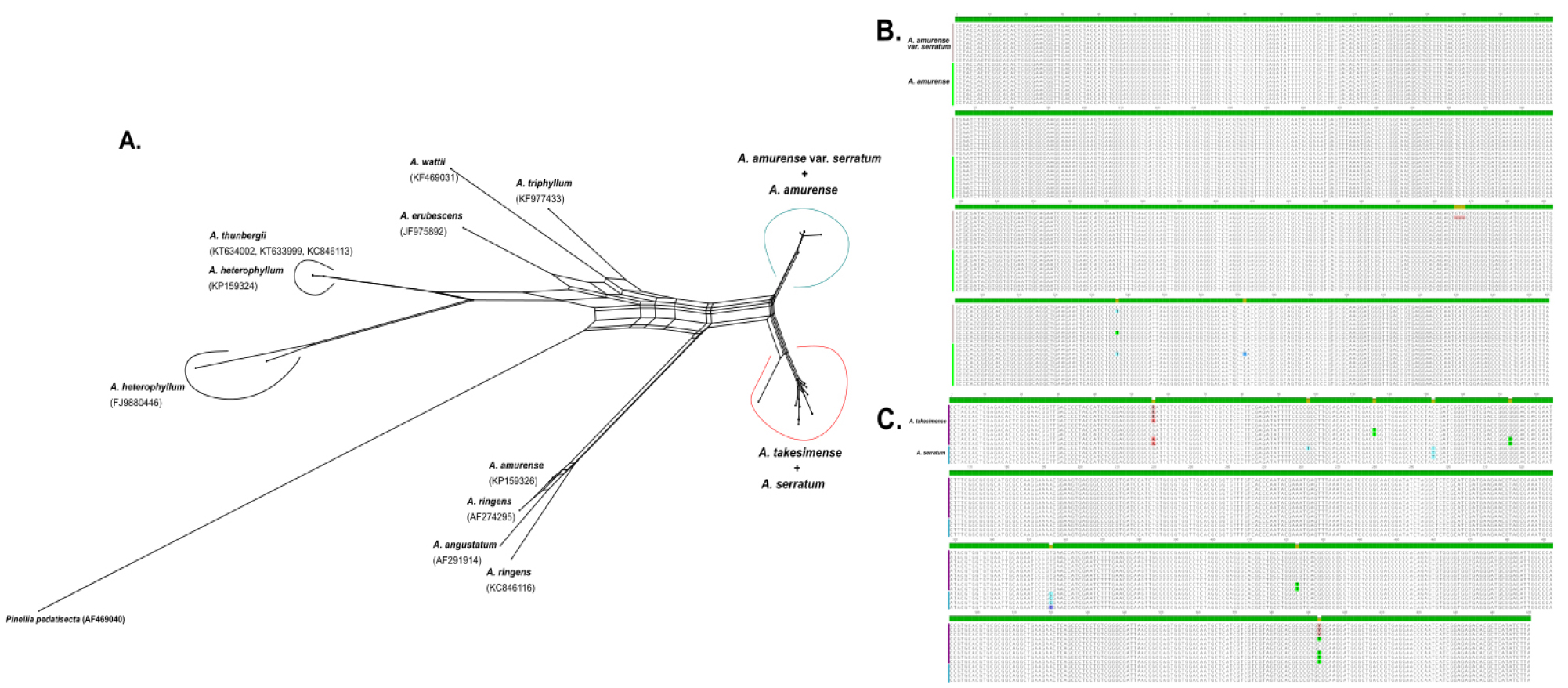
Fig. 4.
(A) Split network of four Korean Arisaema taxa in sect. Pistillata based on nrDNA ITS sequences. (B) Comparison of variable nucleotide sites in ITS sequences between A. amurense var. serratum and A. amurense. (C) Comparison of variable nucleotide sites in ITS sequences between A. serratum and A. takesimense.
고 찰
본 연구에서는 한국에 분포하는 천남성속 sect. Pistillata 4분류군을 대상으로 외부 형태형질과 nrDNA ITS 염기서열을 비교하여 기존 문헌에서 진단 형질로 제시되어 온 형질들의 유효성과 분류학적 처리의 타당성을 재검토하였다. 외부 형태학적 형질 관찰 결과, 전통적으로 (1) 부속체 형태(원통형/곤봉형), (2) 엽연 거치의 유무, (3) 소엽 표면의 백색 무늬 등은 분류군마다 선행 문헌과 유사한 경향이 존재했으나, 개체마다 변이 폭이 크고 중첩되는 분류군이 존재하기에 검색 형질로 사용하기에 한계가 있었다.
천남성-둥근잎천남성의 분류학적 재고찰
이전 연구에서 Chang et al. (2014)이 천남성을 둥근잎천남성의 이명으로 처리하였지만 Ko and Kim (1985)은 엽연의 거치 유무를 기준으로 천남성과 둥근잎천남성을 독립된 분류군으로 주장하였다. 외부형태학적으로 두 분류군이 줄기 무늬의 부재, 장상엽, 화서와 잎의 높이 등에서 유사성이 관찰되었으며, 엽연 거치 및 소엽 수나 소엽 크기와 같은 일부 정량 형질에서 차이가 나타났다. 다만 이러한 차이는 개체마다 변이가 넓게 관찰되었으므로 검색 형질로는 다소 부적합한 것으로 판단되었다. ITS 분석 결과 두 분류군이 하나의 분계조를 형성하였고, ITS 염기서열 분석에서 확인된 변이의 수 또한 매우 적었다. 따라서, 본 연구의 외부 형태 및 분자적 결과는 Chang et al. (2014)이 제시했던 천남성-둥근잎천남성의 통합적 처리 가능성을 시사하였다.
점박이천남성-섬남성의 분류학적 재고찰
섬남성의 분류학적 처리는 연구자에 따라 독립 종으로 인정되거나(Flora of Korea Editorial Committee, 2007; Lee, 1976; Nakai, 1929), 점박이천남성 또는 근연 분류군의 이명으로 처리되는 등 견해가 엇갈려 왔다(Chang et al., 2014). 특히 Chang et al. (2014)은 섬남성을 점박이천남성의 이명으로 보았던 반면, Nakai (1929)는 부속체의 형태 차이를 근거로 이를 독립 종으로 취급하였다. 또한, Scholten et al. (2025)은 A. japonicum이 점박이천남성과 구별되는 독립된 단계통군을 형성하지 않았고, Bayes Factor Delimitation (BFD) 분석에서 1종 모델이 지지되어 A. japonicum을 점박이천남성의 이명으로 처리하기도 하였다.
본 연구의 외부 형태학적 형질 관찰 결과, 줄기 무늬의 유무, 조족엽, 잎 수 및 소엽 수 등에서 두 분류군 간 유사성이 확인되었으며, 부속체 형태 역시 두 분류군 모두에서 원통형과 곤봉형이 함께 나타나 분류군 간 경계가 뚜렷하지 않았다. 다만 PCA 분석에서는 두 분류군이 일부 영역에서만 중첩되었고, PC1 축을 따라 비교적 분리되어 분포하였다. ITS 분석 및 phylogenetic network 분석 결과, 하나의 분계조를 형성하며 독립된 분계조를 형성하지 않았다. 한편, Scholten et al. (2025)은 점박이천남성과 우리나라에 자생하지 않는 A. japonicum사이의 분류학적 불명확을 제기한 바 있다. 점박이천남성과 섬남성이에 따라 한국 특산식물인 섬남성과 점박이천남성, A. japonicum 사이의 계통학적 연구가 필요하다. 결론적으로 본 연구의 분자계통학적 연구에서는 점박이천남성과 섬남성 총 6개체만을 사용하여 단편적인 결과가 나타났을 가능성도 배제할 수 없어 추후 연구에서는 지역별 샘플링을 통한 분자계통학적 연구가 수행되어져야 할 것으로 생각되어진다.
적 요
본 연구는 국내 천남성속 sect. Pistillata 내 4분류군(천남성 A. amurense var. serratum, 둥근잎천남성 A. amurense, 점박이천남성 A. serratum, 섬남성 A. takesimense)의 분류체계에 있어 기존에 진단 형질로 활용되어 온 외부형태 형질을 재검토하고 분자계통학적 연구를 수행하였다. 본 외부형태학적 분석 결과 엽연 거치, 부속체 형태, 소엽 무늬와 같은 형태적 형질은 일정한 경향을 보였으나 일부는 중첩되는 경향성을 보여 검색 형질로 사용하기에는 불충분하였다. PCA 결과, 천남성과 둥근잎천남성은 형태적 경계가 명확하지 않았고, 점박이천남성과 섬남성은 다소 제한적인 중첩이 확인되었다. nrDNA ITS 서열을 비교 분석한 결과, 천남성-둥근잎천남성 그리고 점박이천남성-섬남성이 각각 하나의 분계조를 형성하였지만 주된 군집과 다소 벗어난 위치에 배열된 개체가 일부 확인되었다. ITS 염기서열 분석 결과 또한 천남성과 둥근잎천남성은 SNP 변이가 거의 확인되지 않았으나 섬남성과 점박이천남성의 경우 종마다 일관되지 않은 다양한 변이 양상이 나타났다. 이러한 결과는 기존 형태 형질만으로는 종 구분에 한계가 있으며, 점박이천남성과 섬남성 종 경계는 추가적인 연구가 필요하다.