


Introduction
Materials and Methods
Plant materials and shading treatments
Growth and dry weight measurements
SPAD measurement
Photosynthetic pigment analysis
Statistical analyses
Results
Seedling survival responses to shading level
Seedling growth responses to shading level
Dry weight and biomass allocation under shading levels
Photosynthetic pigment responses to shading level
Discussion
Survival responses to shading level
Growth responses to shading level
Biomass allocation responses to shading level
Photosynthetic pigment responses to shading level
Implications for nursery shading management
Introduction
Neolitsea sericea (Blume) Koidz. is an evergreen broad-leaved tree belonging to the genus Neolitsea in the family Lauraceae. In Korea, it is distributed mainly along the southern coast, Jeju Island, Ulleungdo Island, and islands in the western coastal region. The wood of N. sericea is hard and has high strength, and the species has been suggested to have potential value as construction and furniture material as well as for windbreak forests and ornamental planting (Lee et al., 2023; Won et al., 2017). In addition, essential oils from the leaves have been reported to exhibit anti-inflammatory activity (Yoon et al., 2010), and essential oils from the leaves, branches, and fruits have shown antibacterial and antifungal activities (Shyu et al., 2023). Thus, N. sericea is a useful tree species with potential value not only as a wood resource but also as a medicinal and chemical resource. Nevertheless, basic studies on stable seedling production and cultivation techniques remain limited.
Seedling establishment and early growth are sensitive to light environments, and understanding seedling responses to light is essential for determining suitable planting sites, planting density, and management strategies. Light directly affects seedling survival and growth because it is closely associated with energy acquisition through photosynthesis under limited resource conditions (Delagrange et al., 2006; Valladares and Niinemets, 2008). In particular, under restricted light conditions such as forest understories, light availability acts as an important environmental factor determining seedling performance (Kobe et al., 1995; Montgomery and Chazdon, 2002). Excessive light may induce photoinhibition and water stress, whereas excessive shading may limit the accumulation of photosynthetic products and suppress growth (Boardman, 1977; Valladares and Niinemets, 2008). Therefore, identifying appropriate light conditions during the seedling stage is important for nursery production and early establishment management.
Recent studies conducted in Korea have examined suitable light conditions for seedlings of warm-temperate and subtropical tree species. In three-year-old Myrica rubra seedlings, seedling height growth and chlorophyll content were favorable under 35% shading (Yoon et al., 2024), whereas Osmanthus insularis seedlings showed favorable growth and physiological characteristics at 55% relative light intensity (Gu et al., 2024). These findings indicate that seedling growth responses of some warm-temperate and subtropical species vary with light environment and that favorable shading levels may differ among species. Neolitsea sericea has been reported as an evergreen broad-leaved species occurring during vegetation succession in Pinus thunbergii forests on Jeju Island (Hong et al., 2019), and studies on seed germination and propagation methods have been conducted in Korea (Lee et al., 2023). However, few studies have comprehensively evaluated survival, growth, biomass allocation, and photosynthetic pigment responses of N. sericea seedlings to different shading levels after germination. Accordingly, it is necessary to examine growth and physiological responses by shading level to support nursery production and early establishment management of N. sericea seedlings.
This study was conducted to evaluate the effects of shading treatment on the survival, growth, biomass allocation, and physiological responses of N. sericea seedlings and to identify shading levels applicable to nursery management under the present experimental conditions. Survival rate, seedling height, root-collar diameter, biomass allocation, SPAD value, and photosynthetic pigment contents were assessed under different shading levels. Based on the observed growth and physiological responses, this study aimed to provide basic information for stable nursery production and early establishment of N. sericea seedlings and for the development of nursery techniques for useful warm-temperate and subtropical tree species.
Materials and Methods
Plant materials and shading treatments
This study was conducted in a nursery at the Warm-Temperate and Subtropical Forest Research Center, National Institute of Forest Science, located in Sanghyo-dong, Seogwipo-si, Jeju, Korea. Seeds of N. sericea collected in November 2023 were sown and propagated in a greenhouse at the research center in May 2024. Eight-month-old seedlings were used when the shading treatments were initiated on December 13, 2024.
Shading treatments were established at 0%, 35%, 55%, and 75% shading using shade nets with manufacturer-specified shading rates (Pyung Hwa Industry, Korea). A total of 250 N. sericea seedlings were allocated to each shading treatment. Each shading treatment was established as a single treatment plot, and growth and physiological measurements were conducted on randomly selected surviving individuals within each plot. Seedlings in each treatment were irrigated once per week from December 2024 to May 2025 and twice per week from May to October 2025.
Growth and dry weight measurements
To analyze seedling growth characteristics under each shading treatment, survival rate and growth traits, including seedling height and root-collar diameter, were measured. Growth measurements were conducted in May, August, and October. At each measurement time, 30 surviving individuals were randomly selected from each treatment plot. Therefore, growth data from each measurement time were treated as independent cross-sectional data rather than repeated measurements of the same individuals.
At the end of the experiment in October, shoot and root dry weights were measured to compare biomass allocation among shading treatments. Fifteen seedlings were harvested from the population measured at the final observation in each shading treatment. Harvested seedlings were washed with tap water and dried in a drying oven at 65°C for 48 h. The dry weights of leaves, stems, and roots were then measured. The root-to-shoot ratio (R/S ratio; root dry weight/shoot dry weight) was calculated from these values.
SPAD measurement
Relative chlorophyll concentration was estimated using a SPAD-502Plus chlorophyll meter (Minolta, Japan). Five individuals were randomly selected from the 30 seedlings measured at the final growth assessment in each treatment. For each individual, SPAD values were measured on three fully expanded mature leaves without physical damage, located in the upper to middle crown. Three measurements were taken from the central portion of each leaf, and the average value was used as the SPAD value for that individual.
Photosynthetic pigment analysis
Photosynthetic pigment contents in leaves were measured using a dimethyl sulfoxide (DMSO) extraction method (Hiscox and Israelstam, 1979). Leaf samples for pigment analysis were collected from the same leaves used for SPAD measurement. Samples were placed in 1 mL DMSO and incubated in a water bath at 70°C for 2 h to extract pigments.
To determine an appropriate sample amount, a preliminary test was conducted by comparing absorbance at A663 using one to four leaf discs per 1 mL DMSO. Based on this test, two leaf discs were selected as the sample amount because their absorbance fell within the appropriate range of 0.2-1.0 for chlorophyll quantification (Kouril et al., 1999). Absorbance of the extracts was measured in triplicate at 470, 645, and 663 ㎚ using a microplate reader (VersaMax, Molecular Devices, USA), and the contents of chlorophyll a, chlorophyll b, and carotenoids were calculated according to Lichtenthaler (1987). Pigment contents were first calculated as concentrations in DMSO extracts (㎎ L-1) and then converted to an area basis (㎍ ㎝-2) using the extraction volume and the total area of leaf discs. In this study, two leaf discs with a diameter of 6.5 ㎜ were used, and the total leaf disc area was calculated as 0.664 ㎠.
Statistical analyses
Statistical analyses were performed using SAS 9.4 (SAS Institute Inc., Cary, NC, USA) to evaluate differences in growth and physiological responses among shading treatments. Although seedling height and root-collar diameter were measured in May, August, and October, different individuals were measured at each sampling time; therefore, the data were not analyzed as repeated measurements. Growth data were analyzed separately for each measurement time using one-way analysis of variance (ANOVA). Biomass, SPAD value, and photosynthetic pigment contents were analyzed using one-way ANOVA for the final measurement. When a significant treatment effect was detected, differences among treatments were compared using Duncan’s multiple range test. Survival rate was analyzed using a generalized linear model (GLM) with a binomial distribution, considering the proportional nature of the data. Statistical significance was set at p < 0.05.
Results
Seedling survival responses to shading level
Survival rate of N. sericea seedlings differed significantly among shading treatments. In the 0% shading treatment, only seven of 250 seedlings survived, resulting in the lowest survival rate of 2.8%. Survival rates in the 35% and 75% shading treatments were 99.6 and 98.8%, respectively, whereas that in the 55% shading treatment was 82.8% (Table 1). A binomial GLM indicated a significant effect of shading level on seedling survival (p < 0.0001). Because the number of surviving seedlings in the 0% shading treatment was very small, this treatment was excluded from subsequent growth and dry weight analyses. Physiological measurements in the 0% shading treatment were conducted only on the few surviving individuals.
Table 1.
Survival ratez of N. sericea seedlings under shading levels.
| Shading level (%) | Survived | Total | Survival rate (%) |
| 0 | 7 | 250 | 2.8c |
| 35 | 249 | 250 | 99.6a |
| 55 | 207 | 250 | 82.8b |
| 75 | 247 | 250 | 98.8a |
Seedling growth responses to shading level
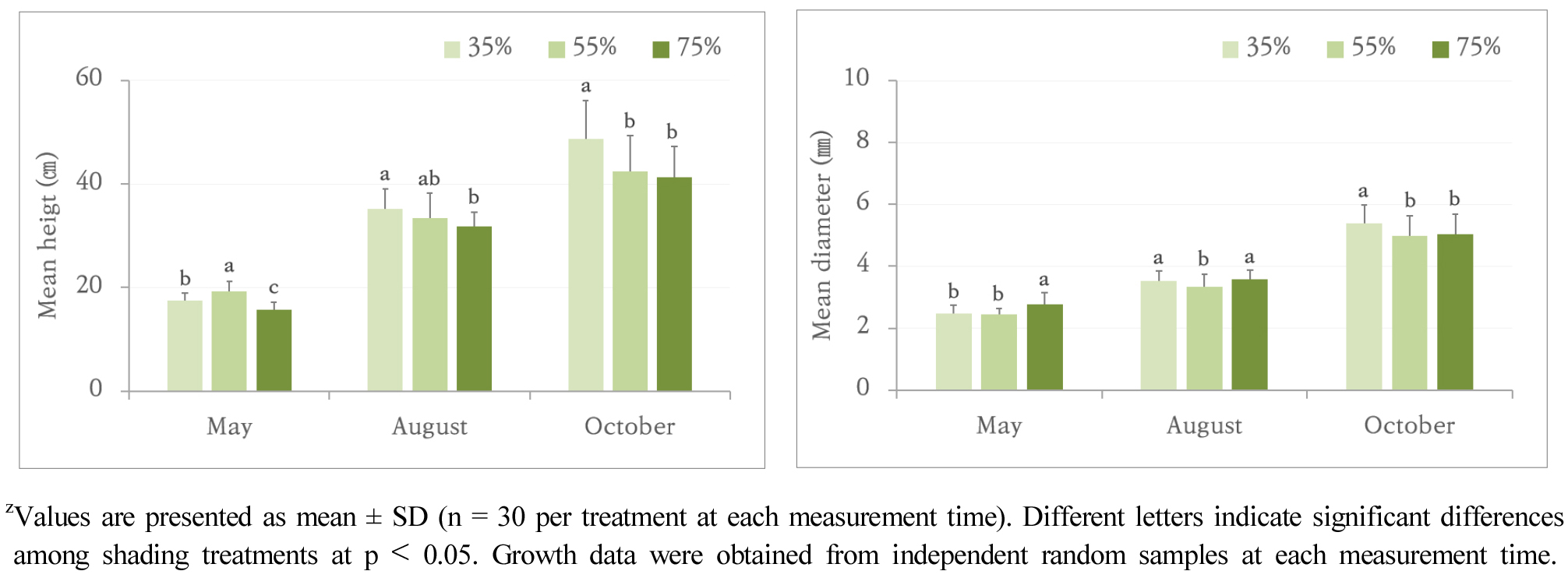
Seedling height and root-collar diameter differed among shading treatments at each measurement time. In May, seedling height was highest under 55% shading, whereas root-collar diameter was highest under 75% shading. In August and October, seedling height was highest under 35% shading. At the final measurement in October, both seedling height and root-collar diameter were greatest under 35% shading (p < 0.05; Fig. 1).
In October, seedling height in the 35% shading treatment was 48.76 ± 7.40 ㎝, which was significantly greater than those in the 55 and 75% shading treatments. Root-collar diameter was also highest in the 35% shading treatment (5.39 ± 0.60 ㎜), showing significantly greater values than those under 55 and 75% shading (Fig. 1). No significant differences in seedling height or root-collar diameter were observed between the 55 and 75% shading treatments.
Dry weight and biomass allocation under shading levels
Leaf, stem, root, and total dry weights did not differ significantly among shading treatments (Table 2). Leaf dry weight was highest in the 35% shading treatment (3.13 ± 0.86 g), followed by the 55% (2.78 ± 0.89 g) and 75% (2.70 ± 0.76 g) shading treatments. Stem dry weight was 1.68 ± 0.47 g under 35% shading, 1.49 ± 0.53 g under 55% shading, and 1.31 ± 0.42 g under 75% shading. Root dry weight was highest under 55% shading, whereas values under 35 and 75% shading were 1.17 ± 0.24 and 0.99 ± 0.24 g, respectively. Total dry weight was highest under 35% shading (5.98 ± 1.50 g), followed by 55% (5.51 ± 1.77 g) and 75% (5.01 ± 1.38 g) shading; however, these differences were not statistically significant.
In contrast, the R/S ratio, an indicator of biomass allocation, differed significantly among shading treatments. The R/S ratio was highest in the 55% shading treatment (0.30 ± 0.08), which was significantly higher than those in the 35 and 75% shading treatments (0.25 ± 0.04 and 0.25 ± 0.03, respectively; Table 2).
Table 2.
Biomass allocationz of N. sericea seedlings under shading levels.
Photosynthetic pigment responses to shading level
SPAD value and photosynthetic pigment contents were analyzed at the final measurement in October (Table 3). SPAD value differed significantly among shading treatments (p < 0.05). The 75 and 55% shading treatments showed the highest SPAD values, 47.16 ± 3.55 and 45.81 ± 2.59, respectively, with no significant difference between them. The SPAD value was 42.55 ± 3.85 in the 35% shading treatment and was lowest in the 0% shading treatment (37.66 ± 3.09).
Among photosynthetic pigments, chlorophyll a, total chlorophyll, and carotenoid contents differed significantly among shading treatments (p < 0.05). Chlorophyll a content was highest under 75% shading (13.61 ± 1.27 ㎍ ㎝-2), followed by 55% shading (11.81 ± 1.76 ㎍ ㎝-2), whereas the 0 and 35% shading treatments showed values of 11.15 ± 2.00 and 10.47 ± 0.90 ㎍ ㎝-2, respectively. Total chlorophyll content was also highest under 75% shading (16.08 ± 1.40 ㎍ ㎝-2), followed by 55, 0, and 35% shading (13.98 ± 1.85, 13.64 ± 2.15, and 12.52 ± 0.96 ㎍ ㎝-2, respectively). Carotenoid content was highest under 75% shading (4.63 ± 0.54 ㎍ ㎝-2), followed by 55, 35, and 0% shading (4.20 ± 0.60, 3.77 ± 0.18, and 3.66 ± 0.45 ㎍ ㎝-2, respectively).
Chlorophyll b contents were relatively high in the 0 and 75% shading treatments (2.50 ± 0.17 and 2.49 ± 0.14 ㎍ ㎝-2, respectively), whereas those in the 35 and 55% shading treatments were 2.05 ± 0.14 and 2.17 ± 0.14 ㎍ ㎝-2, respectively. The chlorophyll a/b ratio was lowest under 0% shading (4.43 ± 0.55), whereas values under 35%, 55%, and 75% shading were 5.12 ± 0.41, 5.44 ± 0.64, and 5.49 ± 0.23, respectively. The chlorophyll/carotenoid ratio was highest under 0% shading (3.71 ± 0.21), whereas values under 35, 55, and 75% shading were 3.32 ± 0.13, 3.34 ± 0.26, and 3.49 ± 0.26, respectively (Table 3).
Table 3.
Photosynthetic traitsz of N. sericea seedlings under shading levels.
| Shading level (%) | 0y | 35 | 55 | 75 |
| SPAD | 37.66 ± 3.09c | 42.55 ± 3.85b | 45.81 ± 2.59a | 47.16 ± 3.55a |
| Chlorophyll a (㎍ ㎝-2) | 11.15 ± 2.00b | 10.47 ± 0.90b | 11.81 ± 1.76ab | 13.61 ± 1.27a |
| Chlorophyll b (㎍ ㎝-2) | 2.50 ± 0.17a | 2.05 ± 0.14b | 2.17 ± 0.14b | 2.49 ± 0.14a |
| Total chlorophyll (㎍ ㎝-2) | 13.64 ± 2.15b | 12.52 ± 0.96b | 13.98 ± 1.85ab | 16.08 ± 1.40a |
| Carotenoid (㎍ ㎝-2) | 3.66 ± 0.45b | 3.77 ± 0.18b | 4.20 ± 0.60ab | 4.63 ± 0.54a |
| Chlorophyll a/b | 4.43 ± 0.55b | 5.12 ± 0.41a | 5.44 ± 0.64a | 5.49 ± 0.23a |
| Chlorophyll/carotenoid | 3.71 ± 0.21a | 3.32 ± 0.13b | 3.34 ± 0.26b | 3.49 ± 0.26ab |
Discussion
Survival responses to shading level
In this study, the survival rate of N. sericea seedlings under full sunlight (0% shading) was extremely low (2.8%), indicating that strong light acted as a severe stress factor during the seedling stage. Evergreen broad-leaved seedlings exposed to excessive light may experience photoinhibition and water stress associated with increased leaf temperature, which can limit early establishment and growth (Valladares and Niinemets, 2008). Under high-light conditions that exceed the capacity of photoprotective mechanisms, photoinhibition and photooxidative damage may reduce photosynthetic efficiency and carbon assimilation (Demmig-Adams and Adams, 1996).
In contrast, survival rates were generally high under the 35~75% shading treatments (82.8~99.6%), suggesting that N. sericea seedlings can survive stably under a certain degree of shading. This response is consistent with the typical light-adaptation pattern of shade-tolerant species that occur in forest understories or semi-shaded environments (Kitajima, 1994; Lusk, 2002). However, the relatively lower survival rate observed in the 55% shading treatment cannot be fully explained by physiological responses to shading level alone. In this study, microclimatic conditions, drainage status after irrigation, and pest or disease incidence were not quantitatively compared among treatment plots. Therefore, the lower survival rate under 55% shading may partly reflect differences in microenvironmental or plot conditions in addition to the effect of shading level itself. Further studies using independent replicated blocks and measurements of actual light and microenvironmental conditions are needed to verify this result.
Growth responses to shading level
Seedling height and root-collar diameter of N. sericea differed depending on shading level, and both traits were greatest under 35% shading at the final measurement. These results suggest that 35% shading was relatively favorable for height and root-collar diameter growth of N. sericea seedlings under the present nursery conditions. This may be because 35% shading reduced excessive light stress while providing more light for growth than the 55 and 75% shading treatments.
In general, shade-tolerant species can survive under low-light conditions, but excessive light limitation can reduce growth by decreasing the accumulation of photosynthetic products (Boardman, 1977). The greater seedling height and root-collar diameter observed under 35% shading in this study can therefore be interpreted as a response to a condition that moderated strong-light stress while still providing sufficient light for growth. In contrast, although the 75% shading treatment was favorable for survival and pigment accumulation, final growth was lower than that under 35% shading, indicating that heavy shading may limit long-term growth.
Biomass allocation responses to shading level
Leaf, stem, root, and total dry weights did not differ significantly among shading treatments, whereas the R/S ratio differed significantly and was highest under 55% shading. This suggests that the response of N. sericea seedlings to shading level may be reflected more sensitively in biomass allocation patterns than in absolute total biomass accumulation. Plants adjust biomass allocation among organs to acquire resources effectively under different environmental conditions (Bloom et al., 1985). In evergreen broad-leaved species, relatively high root biomass allocation may be maintained even under low-light conditions compared with deciduous broad-leaved species (Lusk, 2002).
The higher R/S ratio under 55% shading indicates that shoot growth and root biomass allocation of N. sericea seedlings may respond differently to shading level. This pattern is consistent with the concept that plants regulate biomass allocation toward organs that improve resource acquisition under given environmental conditions (Bloom et al., 1985). However, because total dry weight did not differ significantly among shaded treatments, the higher R/S ratio should be interpreted as a shift in allocation pattern rather than as an increase in overall seedling biomass.
Photosynthetic pigment responses to shading level
Photosynthetic pigment responses of N. sericea seedlings to shading level were reflected in both pigment contents and pigment ratios. In this study, SPAD value showed a trend similar to that of total chlorophyll content, and chlorophyll a, total chlorophyll, and carotenoid contents were highest under 75% shading. Plants commonly increase leaf chlorophyll content under low-light conditions to use limited light more efficiently (Boardman, 1977). Carotenoids also function in accessory light harvesting and photoprotection in response to changes in light environment (Demmig-Adams and Adams, 1996). Therefore, the higher pigment contents observed under 75% shading can be understood as a physiological acclimation response of N. sericea seedlings to low-light conditions.
However, the SPAD value and photosynthetic pigment contents measured in the 0% shading treatment were obtained from only a few surviving individuals after extremely low survival. Therefore, these data may not represent the physiological responses of the entire seedling population under full sunlight and should be interpreted with caution due to possible survivor bias.
The chlorophyll a/b ratio was lowest under 0% shading and was relatively similar among the shaded treatments, whereas the chlorophyll/carotenoid ratio was highest under 0% shading and relatively low under shaded conditions. The chlorophyll a/b ratio reflects the relative composition of light-harvesting complexes and reaction center pigments, whereas the chlorophyll/carotenoid ratio may be interpreted as an indicator of the relative balance between light-harvesting and protective pigments (Anderson et al., 1995; Demmig-Adams and Adams, 1996; Walters, 2005). Considering these points, the relatively small differences in these ratios among the 35~75% shading treatments suggest that pigment composition was comparatively stable within the range of shaded conditions. In other words, N. sericea seedlings adjusted the total amount of pigments with increasing shading level, while maintaining the relative composition of pigments within a limited range.
Nevertheless, the 75% shading treatment, which showed the highest pigment contents, did not produce the greatest growth. Seedling height and root-collar diameter were highest under 35% shading. This indicates that higher pigment contents under 75% shading were more closely associated with physiological acclimation to low-light conditions than with maximum growth. Thus, pigment accumulation and seedling growth may not respond in the same direction in N. sericea seedlings under different shading levels.
Implications for nursery shading management
Overall, N. sericea seedlings showed different patterns in survival, growth, biomass allocation, and photosynthetic pigment responses depending on shading level. The 35% shading treatment resulted in high survival and the greatest seedling height and root-collar diameter, suggesting that it was relatively favorable for early shoot growth. The 55% shading treatment showed a higher R/S ratio, indicating a distinct biomass allocation response, whereas the 75% shading treatment showed higher SPAD value and pigment contents, indicating a stronger physiological acclimation response under heavy shading. These results suggest that N. sericea seedlings can regulate morphological and physiological responses according to light environment. Valladares and Niinemets (2008) reported that shade-tolerant species can exhibit various levels of plasticity in response to light environments, and the present results similarly indicate that growth, biomass allocation, and pigment responses of N. sericea seedlings may vary with shading level during nursery production.
Under the present experimental conditions, 35% shading may be considered a suitable initial shading level for nursery production and propagation of N. sericea seedlings because survival rate was high and height and root-collar diameter growth were favorable. However, because total dry weight did not differ significantly among treatments, 35% shading should not be regarded as an overall optimum condition in all respects. Rather, it should be interpreted as a relatively favorable condition for survival and early shoot growth. In addition, the distinct biomass allocation and pigment responses observed under 55 and 75% shading indicate that shading level may need to be adjusted according to management objectives, rather than solely based on growth performance.
This study has several limitations. Each shading level was established as a single treatment plot, and independent replicated blocks were not included. In addition, shading levels were defined using manufacturer-labeled shading rates, and actual relative light intensity or photosynthetic photon flux density (PPFD) was not measured quantitatively in each treatment plot. Although treatment differences were analyzed using individual seedling measurements, the results should be interpreted as trends observed under the present experimental conditions rather than as absolute treatment effects of shading level. Future studies should incorporate independent replicated blocks and actual light measurements to further verify the responses of N. sericea seedlings to shading level.